
Credit: XL Recordings
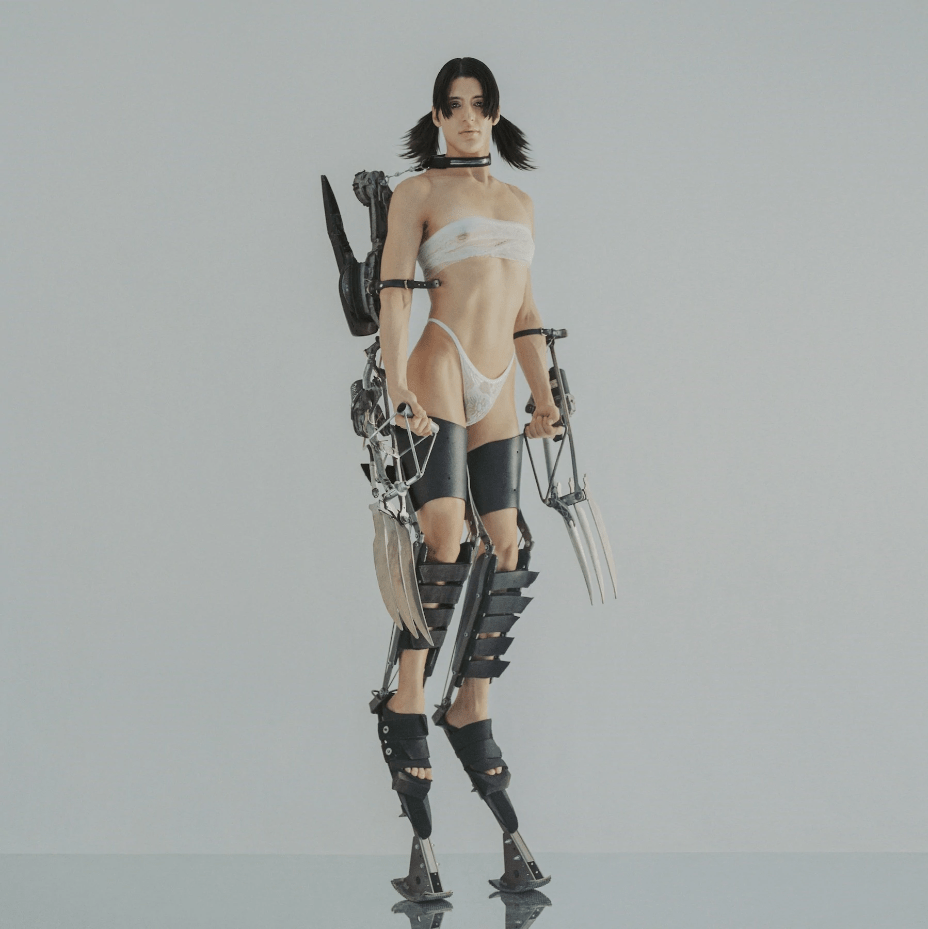
“I do what I wanna do when I wanna do it,” purrs Arca defiantly at the start of Kick i opener “Nonbinary.” The record rides this same braggadocious energy throughout its runtime, using the chaotic avant-garde of the Venezuelan producer (whose real name is Alejandra Ghersi) to create her most unapologetic and distinctive work yet. For one, the album diverges from her previous ambient sound, evolving her unorthodox take on electronic music to the next level with poppier, cyberpunk-tinged production and more prominent vocals. But more notably, the record was inspired by the singer’s coming out as a nonbinary transgender woman in 2018 and what she calls “self-states,” or different elements of her being. By making her identity the centerpiece of Kick i, Ghersi created a glitch-pop queer manifesto that revels in authenticity and stuns with its ethereal production.
And Kick i still packs the same punch one year later. Throughout the record, Ghersi fully explores her range as a musician, rapping, performing in sprechgesang, and singing with operatic timbre. But she also explores her breadth as a human being, infusing different self-states into each track. The aforementioned “Nonbinary” sets the tone with its lack of structure, disarrayed synths, and self-empowerment themes. Ghersi adds a touch of nonchalant badassery to the song, sprinkling in tongue-in-cheek lyrics like “What a treat / It is to be / Nonbinary / Ma chérie / Tee-hee-hee.” Spanish-language track “Mequetrefe” plays with similar themes, featuring an experimental reggaetón beat under the singer’s pitched-up vocals as she sings about displaying confidence despite the threat of anti-trans street harassment. Over a thunderous blend of drums and synths, she proudly recalls walking to a club instead of using public transportation so that everyone can see her: “Ella vino caminando desde su casa / Ella no toma taxi / Que la vean, que la vean en las calles” (“She came walking from her house / She doesn’t take a taxi / Let them see her, let them see her on the streets”).
Despite her confident demeanor, Ghersi also makes room for vulnerability, celebrating both the woes and joys of her life. In “Calor,” she proclaims her devotion to her now ex-boyfriend, Carlos Saenz. Enveloped by melancholic keys, she sings, “Eres el premio que no me esperaba / Eres el dueño de todo mi ser” (“You are the reward that I didn’t expect / You are the master of all of my being”). But not all of the singer’s relationships are idyllic, and she takes this knowledge in stride as she claps back at haters in “Riquiquí.” She uses catchy wordplay (“Regenerated girl degenerate to generate heat in the light”) and witty production choices that elevate her lyrics — for instance, she weaves meowing sounds into the outro as she likens herself to a cat moving in slow motion.
While Kick i centers on Ghersi’s experiences as a trans woman, it features numerous collaborations that add different dimensions to its themes of gender and self-love. In the dystopian electropop track “La Chíqui,” late Scottish producer SOPHIE and Ghersi discuss their identities as trans people with cryptic (often bizarre) lyrics. Over clunky, distorted drums, the former plays with gendered language (“She is my boyfriend”) while the latter sings about meneando (Spanish for “shaking it”) with pitched-up vocals. “Afterwards” is similarly psychedelic, as Björk recites an excerpt from Spanish poet Antonio Machado’s “Anoche cuando dormía,” the dreamy metaphors of which serve as a backdrop for Ghersi’s more somber verses about pain and healing. The livelier “KLK” features a siren-like melody and makes a nod to the Venezuelan singer’s heritage with its furruco-driven beat. As Ghersi raps ad-libs like “¿Qué lo que?” (Dominican slang for “What’s up?”), alternative flamenco singer ROSALÍA celebrates their triumphs in life: “‘Toy viviendo la vida / Ay, como yo quería” (“I’m living life / Oh, the way I wanted to”).
In its final moments, Kick i slows down pace as Ghersi delivers some of her most heartfelt songs. In the ballad “Machote,” which she describes as a gender-swapped cover of “Quiero una Chica” (“I Want a Girl”) by Latin Dreams, she divulges her desire for a macho man (who knows how to menear, of course). But the singer desires more than just his body: “Quiero todo de tu cuerpo / Quiero todos tus lamentos / Eres el que más anhelo” (“I want all of your body / I want all of your laments / You are the one I long for”). Closing track “No Queda Nada” continues this romantic theme, as she revisits her love for Saenz. Over minimalistic electronic instrumentals, Ghersi lifts her veil of confidence completely and gives her all to him with the words “No queda nada, sino yo en ti” (“There is nothing left except for myself in you”). She turns to introspection in the final verse, somberly singing, “No queda nada en mí / Una y otra vez” (“There is nothing left in me / Again and again”).
Ghersi gives her all in Kick i, until there is nothing left in her but the beautiful mess of a glitch-pop masterpiece she created. The record is like an extension of the singer herself, filled with all of the intricacies — both the euphoria and dysphoria — of the trans experience. And a year later, the record’s heart-wrenching candidness and inventive Latin electropop fusion sound still endure, placing it firmly as the producer’s magnum opus in her discography.

 C.S. Harper